Leveraging a chromosomal instability-based signature to predict the prognosis and immune landscape of breast cancer
Leveraging a chromosomal instability-based signature to predict the prognosis and immune landscape of breast cancer
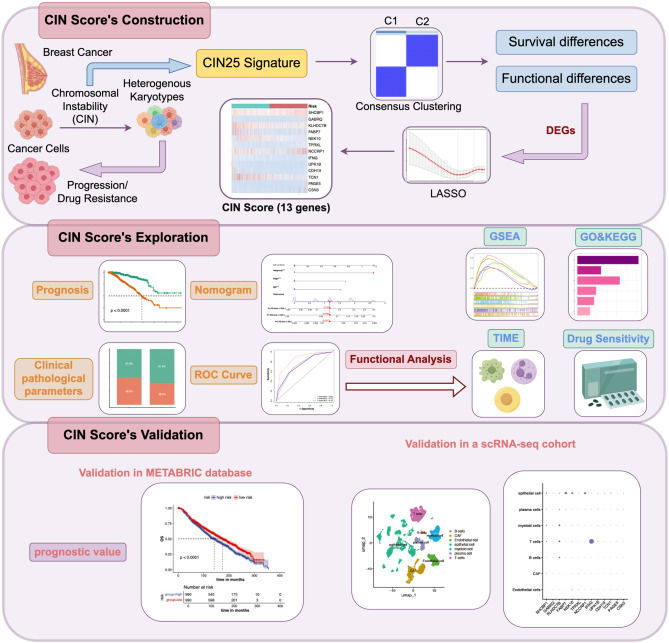
Chromosomal instability (CIN) significantly impacts the tumor progression and tumor immune microenvironment (TIME). However, few researchers have focused on CIN variables in predicting prognosis and the immune landscape of breast cancer. Through unsupervised consensus clustering, the TCGA-BRCA cohort was categorized into two clusters based on the CIN25 gene signature. After identifying the two clusters’ differentially expressed genes, we sequentially performed univariate Cox, LASSO, and multivariate Cox regression analyses to construct a 13-gene signature, termed “CIN score”. Then, the breast cancer patients were divided into low- and high-CIN score groups. The differences in survival outcome, clinicopathological parameters, TIME, and drug sensitivity between the two groups were further investigated. The high-CIN score group had unfavorable clinicopathological features and overall survival. TIME analysis indicated that the low-CIN score group had increased expression of immune checkpoint genes and infiltration of immune cells, suggesting that immunotherapy was more likely to benefit the low-CIN score group. Additionally, drug sensitivity analysis indicated the high-CIN score group has lower sensitivity to several commonly used chemotherapeutic, endocrine, and targeted agents than the low-CIN score group. The novel gene signature, CIN score, identified in our research, offers a novel tool to predict the prognosis, TIME, and drug responsiveness in breast cancer, thus providing insights into immunotherapy decision-making and contributing to the precision treatment in breast cancer.