Integrative analysis reveals the clinical utility of cancer-associated fibroblast-derived signature, and its implication for young-onset thyroid cancer
Integrative analysis reveals the clinical utility of cancer-associated fibroblast-derived signature, and its implication for young-onset thyroid cancer
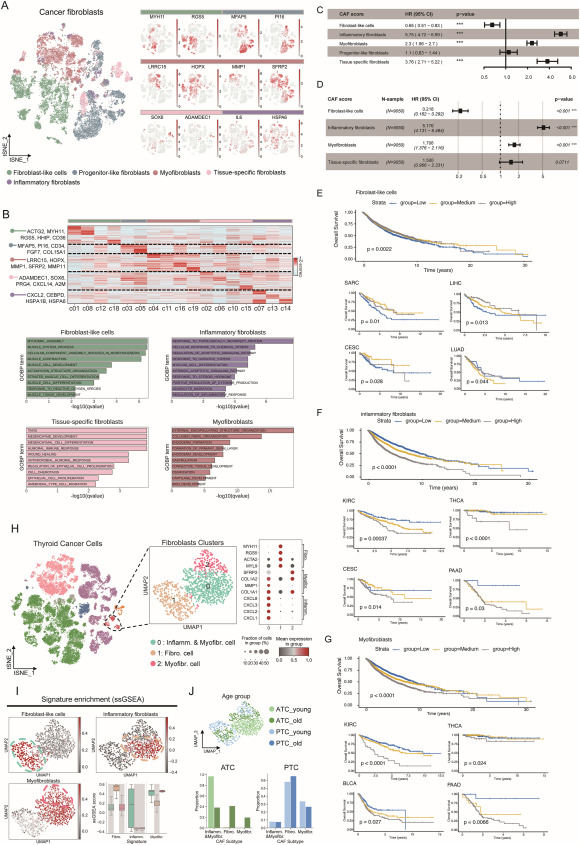
Thyroid cancer is the most common endocrine malignancy worldwide. Although prognosis is generally favorable, young patients show more advanced and aggressive features than adults, making prognosis prediction challenging.1 In solid tumors, cancer cells interact with the surrounding environment to form the heterogeneous tumor microenvironment (TME). Among TME components, cancer-associated fibroblasts (CAFs) are key producers of the extracellular matrix and regulators of the TME.2 Single-cell RNA sequencing has revealed diverse CAF phenotypes across cancer types, arising from distinct origins and activation states. This heterogeneity underscores the need to understand CAF diversity to identify tumor-specific biomarkers for guiding personalized treatment and follow-up strategies.3 However, pan-cancer research on CAFs is limited, with very few reports on thyroid cancer.4 This study first identified CAF clusters and signature genes using pan-cancer single-cell data. CAF composition and prognostic relevance were assessed across 23 solid tumors in the TCGA pan-cancer database. Finally, age-related CAF subtypes in thyroid cancer were analyzed.Thyroid cancer is the most common endocrine malignancy worldwide. Although prognosis is generally favorable, young patients show more advanced and aggressive features than adults, making prognosis prediction challenging.1 In solid tumors, cancer cells interact with the surrounding environment to form the heterogeneous tumor microenvironment (TME). Among TME components, cancer-associated fibroblasts (CAFs) are key producers of the extracellular matrix and regulators of the TME.2 Single-cell RNA sequencing has revealed diverse CAF phenotypes across cancer types, arising from distinct origins and activation states. This heterogeneity underscores the need to understand CAF diversity to identify tumor-specific biomarkers for guiding personalized treatment and follow-up strategies.3 However, pan-cancer research on CAFs is limited, with very few reports on thyroid cancer.4 This study first identified CAF clusters and signature genes using pan-cancer single-cell data. CAF composition and prognostic relevance were assessed across 23 solid tumors in the TCGA pan-cancer database. Finally, age-related CAF subtypes in thyroid cancer were analyzed.