Integrated genomic analysis of EDNRB common and rare variants in Hirschsprung disease
Integrated genomic analysis of EDNRB common and rare variants in Hirschsprung disease
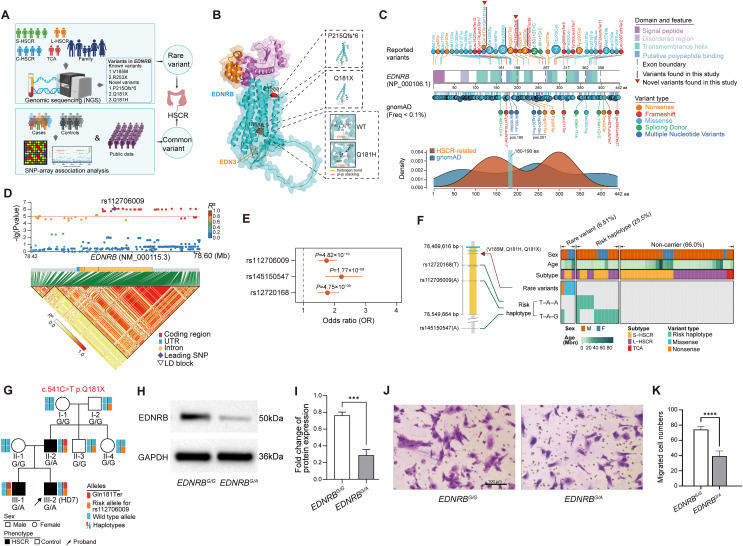
Hirschsprung disease (HSCR) is a congenital intestinal motility disorder characterized by absent enteric ganglia in the distal intestine.1 While HSCR is primarily a genetic disorder, its inheritance pattern is complex and remains largely unexplored.2 Current genetic screening focuses on rare variants of several essential genes (e.g., RET, EDNRB, GDNF, SOX10), which unfortunately could explain only a limited portion of genetic heritability.3 The interplay between common and rare variants may significantly impact disease risk.4 Endothelin receptor type B (EDNRB) is a well-established HSCR contributor5 and was previously considered to explain about 5%–10% of HSCR children. While rare coding EDNRB variants are associated with HSCR, the contribution of common variants and their interaction with rare variants remains unclear. To address this, we conducted a large-scale genetic study involving 553 HSCR participants and 2075 controls from southern Chinese children, employing single nucleotide polymorphism (SNP)-array genotyping, exome sequencing, and genome sequencing (Fig. 1A). Our study aims to elucidate the role of EDNRB in HSCR susceptibility, explore the interplay between common and rare variants, and provide mechanistic insights into HSCR pathogenesis through functional studies.