Human Gordon Holmes Syndrome modeling in mice reveals essential function of RNF216 ubiquitination in spermatogenesis and male fertility
Human Gordon Holmes Syndrome modeling in mice reveals essential function of RNF216 ubiquitination in spermatogenesis and male fertility
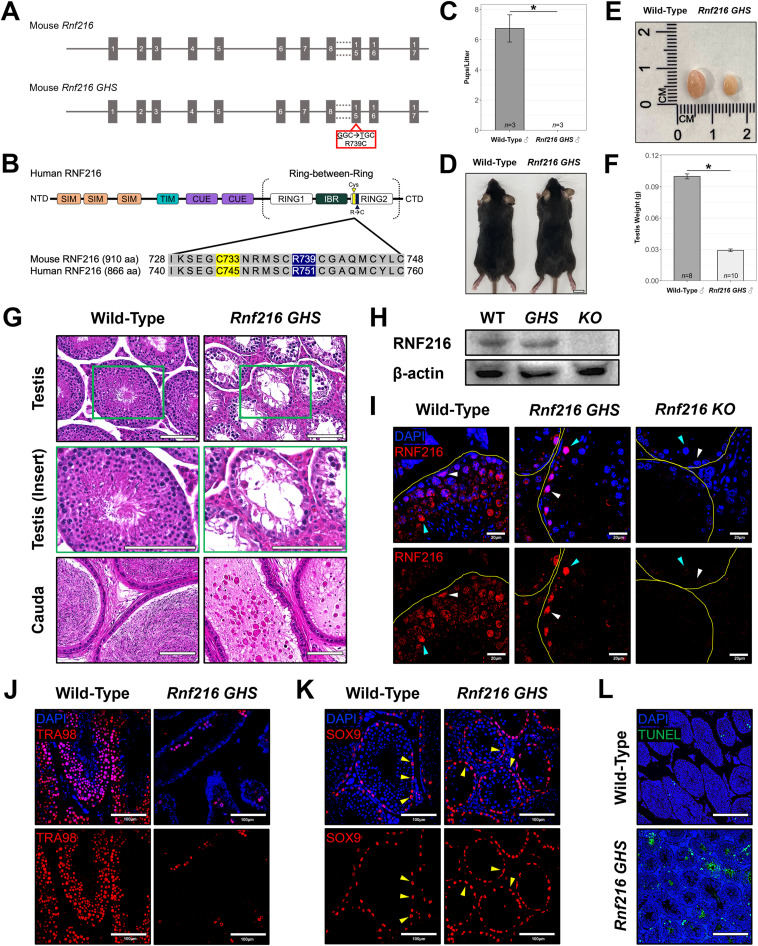
Gordon Holmes syndrome (GHS) is a devastating disease characterized by neurological and reproductive dysfunction, including ataxia, dementia, and hypogonadism. Currently, patients have few positive outcomes, and little is known about disease etiology and progression at the cellular and molecular levels. Whole-genome sequencing of GHS patients identified mutations in Ring finger protein 216 (RNF216/TRIAD3), an E3 ubiquitin ligase, and OTU domain-containing protein 4 (OTUD4), a deubiquitinase.1 Patients harboring either homozygous or compound heterozygous mutations of Rnf216 alone presented both neurological and reproductive phenotypes, suggesting Rnf216 is the primary underlying genetic factor in GHS. Consequently, additional case reports have described GHS to be associated with Rnf216 mutations near the catalytically active ubiquitination region, the Ring-between-Ring (RBR) domain. The RBR domain classifies RNF216 as a specialized subset of E3 ubiquitin ligases due to its mechanism that utilizes both RING domains to coordinate protein ubiquitination. This is also observed in the RBR family member, Parkin, linked to neurodegenerative Parkinson's disease. At the molecular level, RNF216 exhibits an in vitro preference for non-canonical protein ubiquitin chain linkages, lysine-11 (K11) and K63, which are associated with signaling and DNA-damage pathways rather than proteasomal degradation via canonical K48-linked ubiquitination, suggesting that these downstream pathways may be involved in the molecular etiology of GHS2, 3, 4. In addition, analysis of human GHS-associated RNF216 mutations near the catalytically active cysteine in the RBR domain showed that these mutations completely abolished E3 ubiquitin ligase activity in vitro, rendering RNF216 catalytically inactive.2,4 Our group was first to report Rnf216 gene knockout (Rnf216 KO) in mice, which resulted in disrupted spermatogenesis and male infertility, highlighting the essential role of RNF216 in male reproduction.5 However, the key molecular mechanism underlying RNF216-related GHS and its associated reproductive dysfunction remains unclear. To gain a better understanding of the human GHS RNF216 mutation in male reproduction, we generated a novel transgenic mouse model harboring the E3 ubiquitin ligase-inactivating mutation observed in GHS patients.