SERTAD4-AS1 suppresses pancreatic cancer progression by stabilizing SERTAD4 and inhibiting the Notch1 pathway
SERTAD4-AS1 suppresses pancreatic cancer progression by stabilizing SERTAD4 and inhibiting the Notch1 pathway
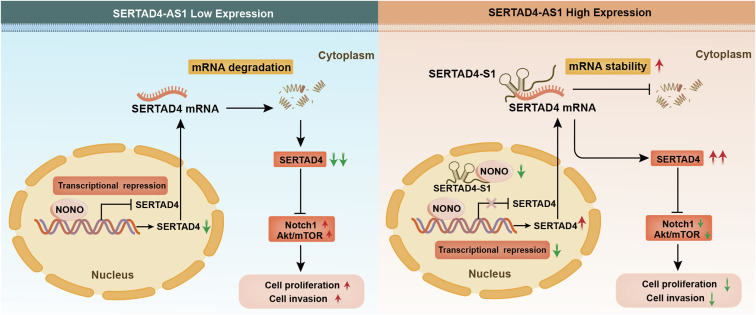
Pancreatic cancer (PC) is a highly lethal malignancy with a poor prognosis.1 Long noncoding RNAs (lncRNAs), particularly natural antisense transcripts, play critical roles in regulating gene expression and tumorigenesis.2 Antisense lncRNAs modulate tumor progression by regulating the expression of their corresponding sense strands and activating downstream signaling pathways.3, 4, 5 However, the specific mechanism of their positive-sense action and the molecular mechanisms of their tumor-promoting or tumor-suppressive effects remain undefined. In this study, we demonstrated that SERTAD4-AS1 inhibited the proliferation and invasion of PC cells through the Notch1 signaling pathway. Mechanistically, SERTAD4-AS1 stabilized SERTAD4 mRNA by forming a double-stranded RNA structure with SERTAD4. Moreover, SERTAD4-AS1 directly bound to the NONO protein and prevented the transcriptional repression of SERTAD4 by NONO. Collectively, these results suggested the regulatory mechanism of SERTAD4-AS1 and uncovered the importance of the SERTAD4-AS1/NONO/SERTAD4/Notch1 pathway in PC. These findings also indicated that SERTAD4-AS1 may serve as a therapeutic target for PC treatment.