Mechanotransduction and musculoskeletal regeneration: Molecular mechanisms and interdisciplinary applications
Mechanotransduction and musculoskeletal regeneration: Molecular mechanisms and interdisciplinary applications
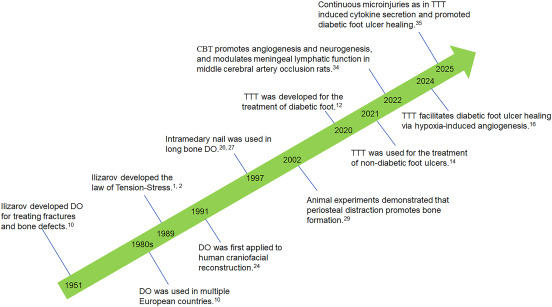
Distraction osteogenesis, or the Illizarov technique, induces bone regeneration using distractive mechanical forces. Nevertheless, Wolff's law holds that bone adapts to reverse compressive mechanical loads, growing denser in areas of high pressure and resorbing in zones of low pressure. These two forms of new bone formation together suggest that mechanical stimuli play an important role in bone remodeling and regeneration. The therapeutic efficacy of distraction osteogenesis has been recognized in orthopedics and maxillofacial surgeries. Distraction osteogenesis was even used for the regeneration of various other tissues/organs, such as blood vessels and skin (e.g., in the treatment of limb ischemic diseases and foot ulcers), suggesting the principle of distraction histogenesis. However, the underlying mechanisms, particularly those of the cross-organ effects and in terms of mechanotransduction, remain poorly understood. Thus, this review aims to explore the recent advances in research on musculoskeletal regeneration and its association with mechanosensitive channels from a new interdisciplinary application perspective. The contents can provide insights into potential research directions for understanding the molecular mechanisms of musculoskeletal regeneration and its clinical applications.