A parallel-risk framework accurately predicts hematopoietic stem cell transplantation outcomes and identifies benefiting patients in pediatric AML
A parallel-risk framework accurately predicts hematopoietic stem cell transplantation outcomes and identifies benefiting patients in pediatric AML
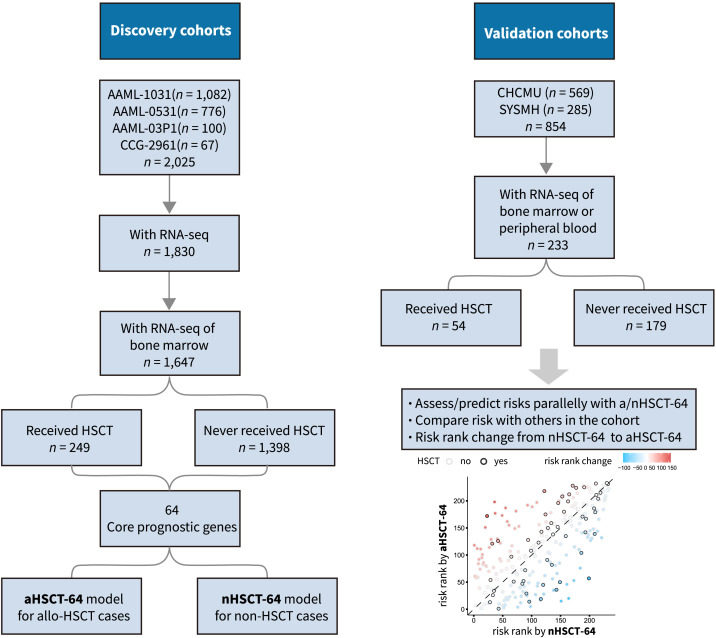
Pediatric acute myeloid leukemia (pAML) has a poorer prognosis than acute lymphoblastic leukemia, and hematopoietic stem cell transplantation (HSCT) offers curative potential in high-risk or relapsed cases. Current models cannot accurately determine which individual patients will truly benefit from HSCT, leading to overtreatment or undertreatment. We developed HSCT-64, the first parallel transcriptomic risk framework for pediatric AML, conceptually analogous to a causal G-formula approach. It comprises two treatment-specific models, aHSCT-64 for allo-HSCT recipients and nHSCT-64 for non-HSCT patients, derived from a shared 64-gene signature identified from diagnostic RNA-sequencing data, enabling individualized survival prediction under both treatment scenarios at diagnosis. Trained on 1647 cases from four COG/TARGET cohorts and validated in 233 independent patients, HSCT-64 achieved a C-index of 0.791 and AUC of 0.794 for allo-HSCT overall survival, outperforming existing clinical, cytogenetic, and leukemia stem cell-based models. Comparing risk ranks between two models identified an HSCT-benefiting subgroup patients with a predicted risk rank reduction from HSCT who experienced a 5.88-fold mortality reduction post-transplant (Hazard Ratio, HR = 0.17, P = 0.0066), while no survival gain was seen in the nonbenefiting subgroup (HR = 0.94, P = 0.899). HSCT-64 enables precise, diagnosis-time identification of pAML patients most likely to benefit from transplantation, marking a shift from high-risk-based recommendations toward individualized, transcriptome-driven decision-making.