ATOX1 overexpression mitigates copper homeostasis in microglia: Implications for Alzheimer's disease therapy
ATOX1 overexpression mitigates copper homeostasis in microglia: Implications for Alzheimer's disease therapy
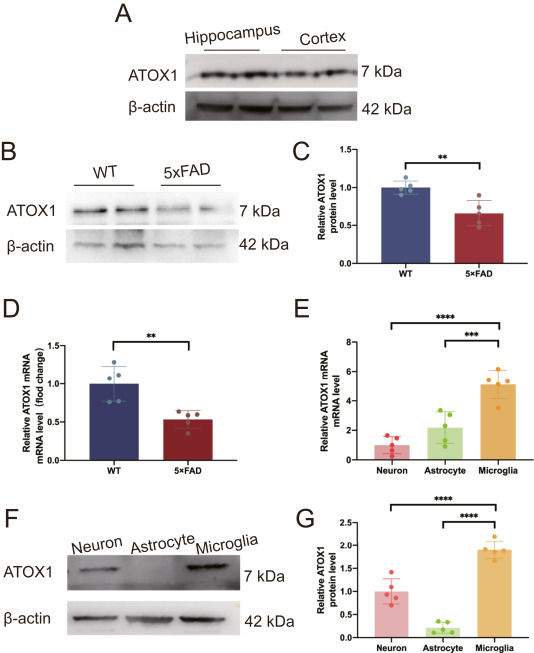
Copper (Cu2+) is a known contributor to the pathogenesis of Alzheimer's disease (AD). However, it is uncertain whether proteins regulating copper homeostasis affect Cu2+ in microglia. Antioxidant protein 1 (ATOX1) plays a key role in Cu2+ homeostasis, oxidative stress, and cell protection. Despite its critical functions, the role of ATOX1 in AD pathology remains poorly defined. This study aims to examine the effects of ATOX1 on oxidative stress, apoptosis, and neuroinflammation in microglia by modulating Cu2+ homeostasis. In vivo, a 5 × FAD mouse model was used to investigate the localization and expression of ATOX1 in AD by immunofluorescence and three-dimensional reconstruction. The Aβ1-42 oligomer was used to establish an AD model in vitro. The role of ATOX1 in Cu2+ homeostasis regulation in microglia was further studied using co-immunoprecipitation, Western blotting, quantitative real-time PCR, and spectrophotometry. A reduction in ATOX1 expression was noted in Aβ-plaques-associated microglia compared with normal microglia. Cu2+ levels were elevated in the in vitro AD model, and ATOX1 directly regulated copper homeostasis via P1B-ATPase (ATP7B) in microglia. Excessive Cu2+ induced oxidative stress, neuroinflammation, and apoptosis. Overexpression of ATOX1 alleviated this neurotoxicity, indicating its potential to alleviate oxidative stress, cell apoptosis, and neuroinflammation in AD. ATOX1 overexpression offers protective effects on microglia through Cu2+ homeostasis, which may lead to potential therapeutic strategies for AD.