Uncovering genes driving developmental stage progression in prostate cancer through spatial transcriptomics
Uncovering genes driving developmental stage progression in prostate cancer through spatial transcriptomics
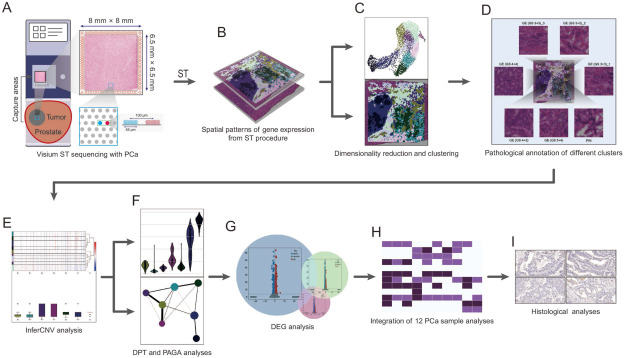
Precisely delineating the transcriptomic profiles of glandular epithelial (GE) cells in prostate cancer (PCa) remains a significant challenge primarily due to their diffuse and multifocal distribution. To address this, we employed spatial transcriptomics (ST) to analyze 12 PCa tissue samples from 10 patients, aiming to identify PCa progression-associated genes by analyzing expression patterns across histologically distinct regions. Transcriptomic classification via principal component analysis (PCA), uniform manifold approximation and projection (UMAP), and Louvain clustering revealed spatially resolved histological structures within each tissue section. The malignancy status, progression stages, and developmental trajectories of GE clusters were further assessed using inferred copy number variation (inferCNV), diffusion pseudotime (DPT), and partition-based graph abstraction (PAGA) analyses. Based on the preliminary characterization of developmental trajectories, pairwise comparisons of GE clusters identified key oncogenes—including TFF3, OR51E2 (PSGR), FOLH1 (PSMA), AMACR (P504S), FOS (a subunit of AP-1), SLC4A4, EGR1, NDUFB9, and H2AFJ—that are positively associated with PCa progression. Immunohistochemistry (IHC) validation further confirmed the elevated expression of SLC4A4 and H2AFJ in advanced-stage PCa. Overall, this study establishes an ST-based framework for predicting PCa progression and provides valuable insight for the identification of progression-associated genes holding promise as clinical biomarkers.