Cis-regulation of FAM49A by a risk variant at 2p24 contributes to the genetic susceptibility of NSCL/P
Cis-regulation of FAM49A by a risk variant at 2p24 contributes to the genetic susceptibility of NSCL/P
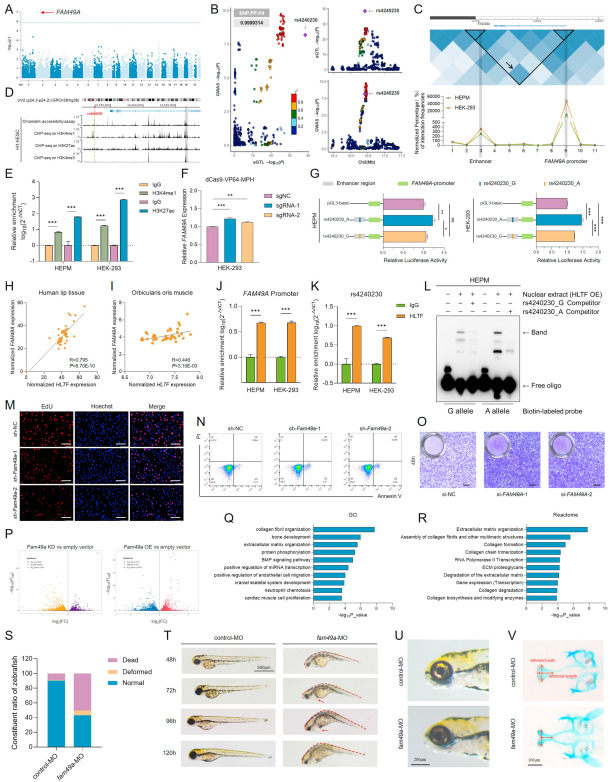
Non-syndromic cleft lip with or without cleft palate (NSCL/P) represents the most common craniofacial malformation worldwide, with an incidence of approximately 1:700 live births. Summary-data-based Mendelian randomization (SMR) integrative analysis of genome-wide association study (GWAS) and expression quantitative trait loci (eQTL) summary data identified FAM49A as an NSCL/P risk gene. The variant rs4240230 (PP4 = 0.99) exhibited causal effects on NSCL/P risk and FAM49A expression in Bayesian co-localization. Chromatin conformation capture (3C) revealed that the rs4240230 locus exhibits frequent physical interactions with the FAM49A gene, and the enhancer activity was validated by chromatin immunoprecipitation (ChIP) and CRISPR activation (CRISPRa). The G allele recruited less HLTF and reduced enhancer activity compared with the A allele in dual-luciferase reporter assays, ChIP and electrophoretic mobility shift assays (EMSAs). FAM49A deficiency inhibited proliferation and increased apoptosis and migration in mouse cranial neural crest cells (O9-1) while disrupting collagen fibril organization, extracellular matrix organization and bone development pathways. Deficient fam49a expression in zebrafish led to shortened body length, spinal curvature, ethmoid plate defects, and elevated mortality/deformity. In conclusion, the variant G allele of rs4240230 reduced HLTF binding affinity to FAM49A, suppressed FAM49A expression, and contributed to NSCL/P susceptibility.